
Brine management aims to reduce the loss of salt water from desalination. Simply put, it is a process that reduces waste and maximizes benefits. For example, the salt is reused or the water is disposed of safely.
This involves modern methods such as zero liquid discharge, evaporation ponds, and proper mixing with water. When brine is handled wisely, marine life is protected. This saves the environment and water is not wasted.
Understanding Brine and Desalination Impacts on the Environment
Desalination produces fresh water, but it also brings with it some problems. The process creates brine, which is very salty and full of chemicals. When this water goes into the ocean, it harms fish and small organisms because the salt content increases and oxygen decreases. In addition, pollution also increases due to the high energy consumption. These effects can be reduced with better planning and clean energy.
Ecological and Marine Life Consequences of Brine Discharge
When too much salt water is released from desalination plants, it is harmful to marine life. The water becomes heavier and sinks, affecting fish and small organisms.
- Habitat degradation: Brine freezes to the bottom of the ocean, suffocating the organisms there.
- Reduced biodiversity: Delicate organisms such as oysters and clams have disappeared.
- Physiological stress: High salt and warm water inhibit the growth and reproduction of organisms.
- Chemical excitation: Chemicals in the brine become different for the pupae and the farm.
- Altered water quality: The water becomes less oxygenated and warmer.
- Effects on specific organisms: Grass, plants, and young fish do not survive, disrupting the food chain
Brine and Desalination Management to Mitigate Impacts Effectively
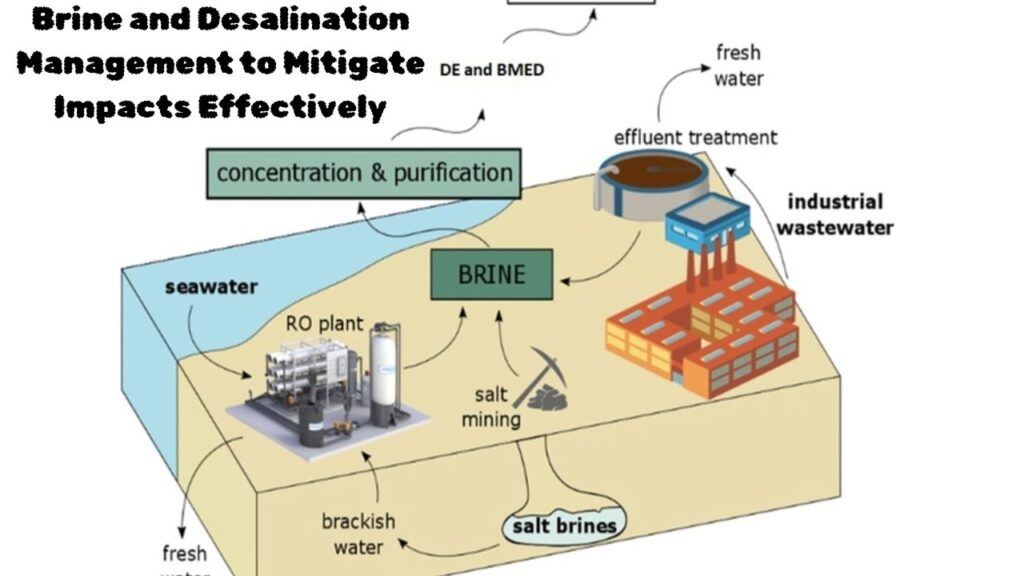
The main objective of brine and desalination management is to reduce losses and increase benefits. For this, the amount of brine is reduced and it is safely mixed with water. Methods such as zero liquid discharge are used so that no waste is left. In some places, salt and minerals are also extracted from the brine. A complete environmental assessment is carried out and a plan is made so that marine life is protected and pollution does not spread.
Advanced Brine Management Technologies and Best Practices
Nowadays, brines are modern for Pakistanis to use less waste and get more benefits. In other words, this word purifies salt water better and saves natural resources from being wasted.
Modern technologies
- Hybrid membrane system: More water is obtained and sampled by combining different filters.
- Electrodialysis (ED/EDR): This method separates the sample and avoids filter clogging.
- Forward osmosis (FO) and membrane distillation (MD): These technologies recover a lot of water but cleaning is necessary.
- Zero liquid discharge (ZLD): In this, water is completely given and only salt is left.
- AI and biomimetic membranes: Intelligent systems and natural filters work faster and better.
- Renewable energy integration: Reduced use of solar and energy.
Best practices
- Integrated systems: Better results can be achieved by combining different conditions.
- Resource recovery: Salt and minerals are reused from the brine.
- Pre-treatment and fouling control: Filters are cleaned before they are shut down.
- Salinity-specific selection: Salt content is appropriately selected.
- Sustainable disposal: If water is to be released, safe and planned procedures are followed.
- Holistic framework: The system is operated in accordance with the environment and laws.
Why Smarter Brine and Desalination Management Matters Long Term
Wise brine and desalination management is essential in the long term. It not only protects the environment, but also provides economic benefits and helps to secure water supplies worldwide. As water scarcity increases, managing brine responsibly ensures that desalination remains a sustainable and safe solution, and does not create new environmental problems.
Conclusion
Effective burn and debris management to mitigate impacts is essential for protecting marine ecosystems, conserving water resources, and ensuring sustainable desalination practices. By adopting modern technologies, proper planning, and resource recovery strategies, we can minimize environmental harm while maximizing benefits. Taking action now helps safeguard biodiversity and supports long-term water security.
Start implementing smarter brine and debris management practices today—explore innovative solutions, monitor impacts, and make sustainability a priority for a healthier planet.